Tuesday, March 18, 2008

Beijing or bust

At last, a U.S. junior national team has broken the cycle!

The story had become cliché: At a major tournament, the Americans dazzle in the first round, raise expectations, then crash out early in the knockout stages. The Under-20s have taken this route at the last two FIFA World Youth Championships, and the U-23s did likewise at the 2004 Olympic qualifying tournament in Guadalajara.

This time around, expectations aren’t as high as the U.S. U-23s enter Thursday’s all-important semifinal against Canada in Nashville. The Americans delivered an underwhelming performance in group play of this Olympic qualifying tourney, scoring one goal in the run of play through three matches, tying a Cuban team full of players who had one foot out the door, and looking nothing like a medal threat come August – that is, if they qualify.

But the game is strange sometimes. Four years ago, the Americans stormed through the group stage, going 3-0-0 with 10 goals scored, only to fall to Mexico in the winner-take-all semifinals.

This time, Peter Nowak’s men have done just enough to get by, but all they have to do now is defeat Canada to earn a trip to Beijing. This team can’t be satisfied with its play thus far, and a little bit of humility might benefit the Americans on Thursday, when they’ll try to break the cycle again – by getting the job done in an elimination game.

In advance of that pivotal match, here’s a look at some of the U.S. players whose stock has risen and fallen since the tournament’s start:

UP

-- Freddy Adu: Easily the most dangerous player on the field for the United States. The attack suffered without him in the Honduras match (as did the set pieces). We saw glimpses of the stepovers and 1v1 skills, but more often (and more importantly), we saw him involve his teammates in the offense. He’s maturing into a leader.

-- Stuart Holden: His hard-nosed tackle in the defensive third launched the Americans’ first legitimate scoring threat against Panama, setting the tone for two strong performances. The Dynamo midfielder displayed an impressive shot, made several threatening, penetrating runs into the box, combined well with Sal Zizzo and Kamani Hill on the right, and played with controlled tenacity. The corner kicks could use some work, though.

-- Dax McCarty: A strong, steady presence in the midfield, McCarty was especially effective against Cuba, winning balls, holding them and distributing them. His touch faltered vs. Panama, but the work rate on the defensive end remained strong.

DOWN

-- Sacha Kljestan: Despite a couple of promising moments vs. Panama, the Chivas USA man struggled badly in the center of the park. His reckless giveaways sparked the Honduran counterattack on multiple occasions, and his clumsy tackle in that match drew a needless yellow card.

-- Patrick Ianni: Nutmegged on the pass that led to Cuba’s goal, Ianni was involved in another defensive breakdown against Honduras, as he and keeper Dominic Cervi got their signals crossed in the opening minutes. Only a questionable foul call prevented the mistake from costing the Americans a goal.

-- Jozy Altidore: Fair or not, expectations are so high for this kid, and his 135 minutes in Tampa didn’t quite measure up. Against Panama, his shirt-pulling foul prevented Kljestan from breaking in alone on the keeper, and his attempt to take on four defenders in the box proved overambitious. Even when he drew a penalty kick, his second touch wasn’t that great, and a better keeper might have read the play well enough to smother the ball rather than pull down Altidore.

QUICK HITS:

Not sure if Kamani Hill will be a great defender, but he certainly shows promise with the ball at his feet. … I like Maurice Edu at defensive midfield more than at center back, but after some initial troubles vs. Panama, he did well at the latter spot. … Good to see Charlie Davies keep his head in the game after missing that PK vs. Honduras. Now he just needs to tone down the acting job. … I can understand leaving Benny Feilhaber off the roster if you have a team that’s running on all cylinders. Nowak’s side hasn’t fit that description yet.

Thursday, March 13, 2008

Oneonta dreaming on such a winter’s day

So, when did the National Soccer Hall of Fame become more exclusive than Augusta National?

U.S. fans have surely been asking similar questions since Tuesday’s announcement of the class of 2008, which includes just two men: UNC women’s coach Anson Dorrance (voted in as a builder) and longtime national teamer Hugo Perez (voted in by the veteran players). None of the 35 players on the ballot received the necessary 75 percent in the regular voting (done by a mixture of Hall of Famers, coaches, media and executives).

Clearly, it must have been a down year for nominees, right?

But it wasn’t. Voters snubbed some of the most influential, most memorable stars of Major League Soccer’s early years – not to mention some of the men who played vital roles in the U.S. national team’s rise from hapless minnow to regional superpower.

As a Hall of Fame voter, I have a hard time figuring out who should make the cut. Is it enough to simply be a fixture on the national team for several years? Do you need to make a certain number of Best XIs? How does experience with an overseas club factor into the equation? Those questions, along with the fact that MLS is still so young, complicate matters. But with all that said, it’s nearly impossible to understand how the following players (along with women’s great Joy Fawcett) didn’t get the nod:

Marco Antonio Etcheverry was the cornerstone of MLS’ first superpower, a sublime talent who gave the league a touch of class and legitimacy in an era of garish uniforms, gimmicky shootouts and shakier skill levels. He led United to three titles and four MLS Cup finals, earning MVP honors in one and getting robbed of them in another (Ben Olsen in ’99? Seriously?), and won the league MVP award in 1998.

Preki ranks ninth in goals and third in assists in MLS history, won two MVP awards (including the 2003 accolade at the age of 40) and claimed a championship with the Wizards. He’s the only American who can say, “I scored the goal that beat Brazil.”

Carlos Valderrama held the career assists mark until Steve Ralston surpassed him last year (El Pibe played five fewer seasons in the league, mind you), and even more than Etcheverry, provided MLS with a dash of credibility in the early days. In terms of pure playmakers, the league still hasn’t seen his equal.

Then we have the near-locks. You could make a case against them, but they still belong in:

Joe-Max Moore scored more goals for the United States (24 in 100 caps) than all but three men, and went to three World Cups. His spot kick against Jamaica clinched a spot at Korea/Japan 2002. And his prolific form in 1999 (15 goals in 29 matches) for the Revolution earned him a spot at Everton, where he initially enjoyed great success – and where he helped lay the foundation for the wave of U.S. field players who have followed him to the Premiership.

Jeff Agoos played 134 times for the Americans, surpassed only by Cobi Jones, and participated in two World Cups. He was a pillar in the backline for three MLS Cup championship teams in D.C., and two more in San Jose. He also was named to three MLS Best XI squads and won the 2001 Defender of the Year award.

What am I missing here? You’ve got three of the most brilliant attackers in MLS history, one of the national team’s greatest goal scorers, and a man picked as one of the top defenders of MLS’ first 10 seasons. Yet only Preki came close to 75 percent (the results are here: http://www.soccerhall.org/Induction/2008/Results/player_results.html). Valderrama only received five more votes than Shannon MacMillan.

Apparently, some voters must have an aversion to selecting established, foreign stars who played in MLS. But the eligibility requirements are quite clear (they’re attached below). Valderrama and Etcheverry qualified for the ballot, they enriched MLS with their performances, and they deserve to be feted with a Yuengling and a slice of cold cheese pizza in Oneonta.

As do Preki, Moore and Agoos. Their careers weren’t perfect. But they were surely among the nation’s best in their time, and that’s whom this Hall of Fame should honor.

And as a footnote, one more gripe:

Sketchy motivational tactics aside, Dorrance has enjoyed an extraordinary run at the University of North Carolina (not to mention his pioneering role with the U.S. women's national team). He's a sure-fire Hall of Famer ... when he retires. The man’s not 60 yet, and he could still pass as Eric Wynalda’s slightly older brother. The Basketball Hall of Fame loves inducting active coaches more than retired players, and it makes the Springfield shrine a farce. Like Geno Auriemma, Jim Boeheim or Mike Krzyzewski on the hoops side, Dorrance doesn’t belong in the Hall of Fame until he’s done coaching.

------------------------------

The eligibility requirements are as follows:
1. Retired as a player for at least three years but no more than 10 years.
2. Played at least 20 full international games for the United States. This requirement is reduced to 10 games if the games were prior to 1990.
3. Played at least 5 seasons in an American first-division professional league, and won either the league championship or the U.S. Open Cup, or was selected as a league all-star at least once.

Saturday, February 09, 2008

Foxboro's future

Before Wednesday night's United States-Mexico match, U.S. Soccer Federation president Sunil Gulati and CEO/secretary general Dan Flynn held court for a roundtable with media members.

With Gillette Stadium not on the list of potential hosts for the semifinal round of World Cup qualifying, I asked where Foxboro stood in the federation's eyes, especially with the installation of FieldTurf during the 2006 NFL season.

“In general terms, leaving Foxboro out of it, we’re not playing in big stadiums in most of these games in the first round, and in a way, it’s hard to play in big stadiums for any of these games because of our opponents," Gulati said. "And we found out the hard way that even when we play in what we would hope is a home-field advantage-type venue, middle America, if we’re playing in a big stadium, we may still get outnumbered. (In) Birmingham, we ended up with a far bigger Guatemalan contingent than I expected (in 2005). Honduras (in 2001) in D.C., obviously.

"We’re going to play the qualifying games in places where everything is riding on winning the game. Foxboro’s been part of that. And in the case of Boston, (there's been) less of an issue with big numbers in the Hispanic community. But we’ve seen when we played El Salvador there or Costa Rica there, there’s been big numbers there.”

Flynn, however, mentioned the Americans' stellar history in Foxboro (7-0-3 at the old Foxboro Stadium, 9-1-1 at CMGI/Gillette) as a factor that can't be ignored.

“Our record is unbelievably good there, and the coach gets input here (when choosing venues), and there’s a comfort level with the surroundings and all those things that maybe creep into a coach’s mindset or a player’s mindset," he said. "The FieldTurf is a little bit unique, but quite frankly, around this country we bring in grass. That’s not what it used to be 10, 15 years ago. I don’t want to be flip about it; it is a lot of work and it is a little bit of extra worry, but our record there is very, very strong. So all of those things get factored in.”

Asked how Hartford's Rentschler Field factors into the equation in terms of serving as another option for New England-based matches, Flynn replied, "Options are good.”

Foxboro hosted two qualifiers in the 1998 World Cup cycle, three in the 2002 cycle and two in the 2006 cycle. Hartford got the nod for one match in the 2006 cycle.

Pat Noonan's parting words

I traveled to Houston this week to freelance the United States-Mexico clasico at Reliant Stadium, and caught up with Pat Noonan following Tuesday's practice. Here are some of his thoughts as he leaves the Revolution and heads to Norway, where he'll join ex-Revs goalkeeper Adin Brown at Aalesund FK.
On the move overseas:
“I’m sure it’ll sink in once I get over there. I’m looking forward to it. I’ve got a familiar face that’ll help me with it, with Adin Brown showing me around, so hopefully that’ll make the transition a little smoother, but I’m looking forward to a new atmosphere. ...

“I’d wanted to go overseas and try something. They have a new coach, a new stadium built. It seems they’re turning things in a good direction. ... It’ll be chilly, but I’m looking forward to the experience.”
“You’re always proving yourself, I think. It’s going to be a new experience, and hopefully I can go in and fit in quickly and contribute right away, and I think if I can do that, it’ll make things a lot easier.”

In a sense, did he feel like the Revs did him a favor by not picking up his option?
“It’s the way you’ve got to look at it. It’s disappointing that they didn’t feel I was still valuable, with not picking up the option, but you know what? It’s a blessing in disguise for me to go overseas and get my foot in the door there and go from there.”
Was the Revs' decision a surprise?
“It was a surprise, no question. I did a lot (for) that organization and I know I have some good years left, so I wasn’t expecting it.”

“With any coach, all you know is they want you to perform. And whether it’s MLS or overseas, you’ve got to be performing with your club to be called into these camps.”
Health update:
“Everything’s going good. The last month’s been good in terms of strengthening and fitness, and hopefully I can go into preseason already a step ahead.”
On failing to win an MLS Cup title with the Revs:
“It’s tough. When you have three chances and you don’t come out with any, it’s tough, and it’s a bummer that I’m going to be heading out there without one. You never know what the future holds; maybe I’ll end up back there, maybe not. But it would have been nice to get one before I left.”
On friend Taylor Twellman's attempts to go to Preston North End:
“It’s a tough time because he’s got a chance to go over and play in a great league and prove himself over there, and he’s not able to do that because they don’t want to let him go. He’s had some very generous offers and they keep rejecting it, and that’s unfortunate because they’re kind of holding him back from a dream.”
On how he's left things with the Revs organization:
“I was close to a lot of people. I’m not going to start bashing them. They know I’m disappointed with their decision (but) there’s no reason to start a war.”

Sunday, November 18, 2007

(Another) open letter to Revolution fans

NOTE: This is an updated version of a column that ran on goldenboot.blogspot.com following last year’s MLS Cup final. It’s remarkable how little needed to be changed.

You poor, miserable bastards.

When I started covering the Revolution in 1999, my days as a supporter instantly ended – they have to when you’re a journalist, and the process is quicker and more painless than you might think.

Now that I’m no longer on the beat, I wondered if I’d subconsciously revert to the old days, when standing in the Fort, singing a drunken rendition of “Super Revolution” and informing the opposing keeper of his undeniable suckitude was ritual.

Alas, once you go hack, you never go back, and I found myself watching Sunday’s MLS Cup final on my couch with the same sense of detachment that I had while sitting on press row in 2002 or 2005. Sure, it was nerve-racking, but once it was over, all that remained was faint disappointment … and pity for you folks.

You supporters have had to suffer through some excruciating moments over the years, and Sunday’s loss only added one more to the list. With a goal in hand and 29 minutes separating the Revs from sweet redemption, it seemed as if an 11-year (and 12-season) quest for glory had finally reached its conclusion. After so many heartbreaking defeats, at last, you’d have your catharsis, your festive release.

And then a dreadlocked Canadian in a Creamsicle outfit stuck a shiv in your back.

****

It’s not easy being a fan of any MLS team. You devote as much time and passion (and in some cases, money) as do supporters of more popular sports, but your countrymen tend to laugh at the effort. The jokes at the office never change (“What was the over/under in that game, 1?”), the bartenders roll their eyes when you ask them to switch just one TV to soccer, and you long ago learned not to even bother with the sports radio guys.
Had the Revs won the MLS Cup, you wouldn’t have been able to share the type of communal joy that swept this region five times over the last six years. The culmination of your 12-year passion would have barely registered among a populace which thinks Sunsing is a Korean electronics brand. The Revs might have held a small rally somewhere, they’d have been introduced at halftime of a Pats game, and then the overwhelming majority of New Englanders would have forgotten about them. I watched as the 2005 Revs filed into the Logan Airport baggage claim following their defeat to the Galaxy; not a soul was there to greet them or, as far as I could tell, acknowledge their existence.
But if I may channel Lt. Frank Drebin: It’s a crazy world, and maybe the problems of an MLS supporter don’t add to a hill of beans, but this is your hill, and these are your beans. Your devotion is as fervent as that of a fan in any other sport, your desire for victory as powerful, your pain in defeat as intense.
And you’ve been hurt in ways that would make Alberto Gonzales queasy.
****
This franchise’s history has rather neatly divided itself into two phases: first, six years of incompetence, in which finishing fourth in a five- or six-team conference rated as progress; and then, six years of vastly improved play besmirched by unimaginably cruel fate.

I don’t work for Elias Sports Bureau, but I can’t imagine that any professional team, anywhere, in any sport, has been ever eliminated from its league’s primary championship in overtime and/or penalty kicks for FIVE STRAIGHT YEARS.
These are the worst types of losses, the ones that leave an aficionado re-watching the TiVo at 1 in the morning, wondering, “What if Griffiths’ shot dipped a little lower? What if Ihemelu hadn’t stuck his head out? What if Ching’s header had gone wide?”
In fact, I suspect you could study the video, do the calculations and determine that those critical moments had come down to no more than a few feet combined. And they all went against the Revs, setting the stage for other moments that left you hollow inside:
Ruiz’s golden goal. Armas’ golden goal. Dempsey’s scuffed PK. Pando (Friggin’) Ramirez’s laser beam. A slow roller from Jay Heaps, landing ever so safely in the arms of Pat Onstad.
The most recent heartbreaker didn’t need extra time (mercifully, I suppose), but it still cut deep. One uncharacteristic moment of defensive chaos, one flash of brilliance from MLS’ version of David Ortiz, and one bullet of a header that somehow stayed out of the net -- and another year’s work went to waste.
The Revs didn’t necessarily deserve victory in all of those matches, but it was there for the taking in each. And every time, it ended in agonizing fashion. At least the Buffalo Bills were blown out in three of those four Super Bowls; clearly, they were out of their league. Your Revs might have been the most talented team in their league over the last six seasons, and they have nothing to show for it. Instead, they join the Bills, Minnesota Vikings, Denver Broncos, Detroit Tigers and Brooklyn Dodgers as the only franchises in North America’s five major leagues to lose in their first four trips to the championship round.
****
After last year’s loss, it seemed as if the window of opportunity had closed. But only Clint Dempsey flew the coop, and even though the organization opted to sit on its share of the transfer fee (perhaps a fatal mistake, given the lack of depth), the team returned in 2007 nearly intact. They put in the work, took care of business and earned themselves yet another opportunity to break through on the American game’s biggest stage.
Once again, they failed.
Continuity and stability have long been considered the Revolution’s strength. However, four Cup final defeats, as close as they may have been, suggest that significant changes might be in order. I’m not sure what the MLS equivalent of trading for Schilling or acquiring Moss, Stallworth and Welker might be, but the Beckham Rule makes it more possible than ever to make a major splash. Plugging in a rookie here and there every season might keep you in the mix for a championship, but it hasn’t produced a league title here. The status quo isn’t working.
As I said at the start, it’s no longer my problem. But I know enough of you guys that it’s impossible not to sympathize. You’ve waited long enough, endured more than your share of anguish (the sports fan’s version, not the real thing, of course) and paid your dues. Sunday should have been your day to rejoice. Instead, it turned into yet another devastating day.
And the thing about franchises (at least, the ones that last, and I suspect the Revs will) is that the fans live with the devastation longer than anyone else. In a few months’ time, one or more of the best players (Michael Parkhurst, leave while you can!) on this team might be competing in different kits, in different leagues, in different nations. Their time in New England will be irrelevant, ancient history; it has to be, because those are the realities of their profession.
The supporters, meanwhile, don’t leave on a multimillion-dollar transfer to Celtic or Fulham. They stay, and they reassemble their hopes and dreams behind whomever management signs. To be a fan is to submit to powerlessness. You don’t pick the manager, you don’t pick the players, you don’t pick the tactics. All you can do is watch, sing, scream, weep. And perhaps, someday, celebrate.

Sunday, July 15, 2007

Finishing touches

Before lamenting the United States’ inability to finish its scoring chances this summer, let’s at least acknowledge that the work – and the skill – that went into said chances. Thirteen years ago, it took a minor miracle (Wynalda’s free kick vs. Switzerland, for example) for the Americans to generate any sort of offense at the World Cup, In the last couple of World Cup cycles, the likes of Reyna, O’Brien, Beasley, Donovan and Dempsey have allowed the U.S. squad to build a far more sophisticated attack. Youngsters such as Feilhaber and Bradley appear primed to expand on those efforts in the next decade.

But damn, can’t anyone put the ball in the net?

At the Gold Cup and Copa America, the United States scored 15 goals in nine matches – not a terrible rate by any means. But one-third of those goals came from the penalty spot, and the total was inflated by a four-spot against an entirely overmatched El Salvador squad. In the Gold Cup, the failure to finish turned what should have been easy victories into nail-biters. At Copa America (particularly the enormously frustrating Paraguay loss), it cost the Americans a shot at advancing to the quarterfinals.

Brian Ching squandered two 1 v. 1 opportunities against the keeper in the first half of the Trinidad and Tobago match alone, then wasted a heroic run late in the Mexico match by plunking the post with what should have been the insurance goal.
Dempsey, Beasley and Eddie Johnson often didn’t press the issue in the penalty area, holding the ball too long or playing it back rather than going to goal.
And for all of the open headers the Americans had in both tournaments, they only scored once with the noggin, courtesy of Carlos Bocanegra in the Panama victory.

Johnson vacillated between dynamic and maddening. As mentioned, he often put himself in position to score, only to pull up and wait for support rather than blowing by the last defender. This tendency drew plenty of attention in the Argentina and Paraguay matches, but it was evident in his first U.S. performance of the summer, against Guatemala. His speed and his tenacity when pressuring defenders are wonderful assets, but his instincts seemed to fail him in the box (and when it came to beating the offside trap). On the whole, he did so many things right in his two Copa America matches that one has to consider his tournament a success.

At 23, however, he needs to take the next step forward, and it should be a giant step across the Atlantic. Perhaps no U.S. player stands to benefit more from a move abroad.

And then we have Taylor Twellman, whose international struggles puzzle me. I covered his first 4½ seasons with the Revolution and saw him thrive under pressure. In 2005, he scored several game-winners and/or equalizers in the waning minutes of the match; it was a run of nearly Ortiz-esque proportions. Sure, you could argue that he struggled in the postseason, with scoreless (and largely invisible) MLS Cup performances in 2002 and ’05 as evidence. But then he buried one against Houston in overtime in last year’s final, and you couldn’t blame him one bit for the shocking equalizer that followed seconds later.

Obviously, the international game is a vastly different creature than MLS, and some guys simply aren’t cut out for the transition. Jason Kreis and Ante Razov are the top two American goalscorers in league history, yet their U.S. careers never took flight. Twellman will likely eclipse them on the leaderboard in the next couple of years; the question is whether he’ll also be a bigger bust with the national team than they were.

Strangely enough, Twellman’s best moments this summer were moments of playmaking rather than scoring. Against Guatemala, he turned a defender, used a burst of speed to break free toward the end line, and slid a nice pass across the goalmouth to Dempsey. And in the Copa America match versus Paraguay, he made a fantastic touch with his back to goal, redirecting Drew Moor’s long ball to Ricardo Clark for the equalizer. Those efforts and a few other smart passes outshined his lone goal of the summer (a shot that nutmegged the Salvadoran keeper in the Gold Cup; it wasn’t a great strike).

They could not, however, compensate for the shoddy finishing: the open header over the bar from 10 yards out against Guatemala, the sitter in second-half stoppage time vs. El Salvador, the left-footer that glanced off the post early in the Panama match, the misfired right-footer later in that game, the header off the post and the weak side volley against Paraguay.

He put himself in position to score in most matches he started (Argentina being a key exception), but repeatedly wasted the opportunity. Maybe it was a case of trying too hard to impress, especially when you know that a couple of fellows named Adu and Altidore are climbing up the depth chart. But Twellman has been part of the national team pool since 2002, he’s still an unproven commodity at this level, and he didn’t help his cause at Copa America, the biggest stage of his career. As a result, one commentator (Phil Schoen) wondered aloud if it was time to send Twellman (and Kasey Keller) to pasture.

I don’t buy it – yet. If he weren’t getting the chances, I’d be more worried, but he’s simply not burying those opportunities he usually finishes off in MLS. It’s not too late for Twellman to replace Brian McBride as the fearless poacher of the national team. McBride was 26 when he made his World Cup debut at France ’98; Twellman was the same age when Bruce Arena controversially bypassed him last year. Bob Bradley would be foolish to give up on him, despite this summer’s disappointments. But his window of opportunity is beginning to close.

Entering World Cup qualifying, Johnson should be a fixture in Bradley’s starting 11. After that, it’s a mix of midfielders in strikers’ clothing (Donovan, Dempsey), underachieving target men (Twellman, Ching) and untested, talented youngsters (Adu, Altidore, Cooper). It’s a group full of potential, but who’s going to convert potential into goals?

Next up, the shaky state of affairs in the back.

Wet Hot American Summer

Thirty minutes into yesterday’s Under-20 World Cup quarterfinal, I was ready to pencil – no, Sharpie – the United States into the final … of the 2014 World Cup.

Freddy Adu had rediscovered the form that made jaws drop in those “60 Minutes” highlights. Jozy Altidore looked like a more dynamic, more predatory version of Eddie Johnson. Robbie Rogers was torching the Austrian defense as if it were an order of crème brulee. Maracana, here they come!

By the end of regulation, however, I was feverishly penning a letter to Sepp Blatter, begging him to revoke the United States’ FIFA membership, to spare the nation any more shame. The second half was that wretched – surely the worst I’ve seen a U.S. team play in years.

Yesterday’s vicissitudes provided a fitting coda to a wild summer for U.S. Soccer: brilliant Gold Cup, brutal Copa America, bittersweet U-20. The performances were all over the map, making it virtually impossible to draw conclusions about the national team’s future. So as we look back on the last month and look ahead to World Cup qualifying, it’s imperative to put the Sharpie away, grab that pencil and resist the urge to mail that manifesto to Zurich.

****
Clearly, no U.S. player made a better impression than Benny Feilhaber, the Hamburger SV midfielder whose golazo won the Gold Cup. That wonderstrike might have been a once-in-a-lifetime moment, but Feilhaber’s quality on the ball is no fluke. Quick combination plays, splendid diagonal passes at inventive angles, precise long balls in transition – he delivered them all. And especially in the Gold Cup, Feilhaber also won his fair share of balls in the midfield.
He faded a bit in the Copa America, perhaps due to fatigue, but even against Paraguay he had his moments, such as a superb ball (struck with the outside of his left foot) that sprung Justin Mapp for what should have led to the equalizer.

Is he the next Claudio Reyna? It sure seems that way.

****
Ricardo Clark had more than a few inspired moments on the ball in addition to tending to his defensive duties. He made an instant impact in the Mexico match, and it’s hard not to note the symbolism of him replacing Pablo Mastroeni in that game. The guard may not have changed yet, but it will soon.

Otherwise, it was a mixed bag for midfielders trying to make a name for themselves. Justin Mapp’s pace and touch on the left flank injected energy into the team at times, but his indecision (and some poor decisions) proved costly at Copa America. Michael Bradley played masterfully at times (particularly the friendly against China) and displayed a solid work rate, but reckless tackles and a dreadful showing against Austrians his own age hurt his final grade.

Perhaps it was merely a coincidence that the United States fell apart against Argentina when Eddie Gaven replaced Ben Olsen, but Gaven did little to prove that it wasn’t, and an improved, earnest showing against Colombia couldn’t erase the sense that he’s nowhere near ready for prime time. Sacha Kljestan showed intermittent flashes of quality on the right side, but also set the tone for the Americans’ nightmarish performance in the box against Paraguay with what Ray Hudson aptly deemed a “toilet-bowl finish” on an open header. Kyle Beckerman and Lee Nguyen didn’t make much of an impact in limited minutes in Venezuela, and Danny Szetela was hard to find against Austria.
A year and a half from now, when the final stage of World Cup qualifying begins, DaMarcus Beasley and either Landon Donovan or Clint Dempsey should still be manning the flanks (with the other up top). All three impressed at the Gold Cup, but all three should impress at the Gold Cup. Meanwhile, Feilhaber and Clark are primed to take control of the central spots, and Bradley and Mastroeni should provide quality depth. It’s a pretty solid midfield. Now the trick is to find some finishers, but that’s a story for another day – perhaps tomorrow.

Monday, November 13, 2006

An open letter to Revolution fans

You poor, miserable bastards.

When I started covering the Revolution in 1999, my days as a supporter instantly ended – they have to when you’re a journalist, and the process is quicker and more painless than you might think.

Now that I’m no longer on the beat, I wondered if I’d subconsciously revert to the old days, when standing in the Fort, singing a drunken rendition of “Super Revolution” and informing the opposing keeper of his undeniable suckitude was ritual.

Alas, once you go hack, you never go back, and I found myself watching Sunday’s MLS Cup final in my office with the same sense of detachment that I had while sitting on press row in 2002 or 2005. Sure, it was nerve-racking (it was a pretty damn exciting match, after all), but once it was over, all that remained was faint disappointment … and pity for you folks.

You supporters have had to suffer through some excruciating moments over the years, but Sunday surely ranked at the top of the list. With a goal in hand and seven minutes separating the Revs from sweet redemption, it seemed as if a 10-year (and 11-season) quest for glory had finally reached its conclusion. After so many heartbreaking defeats, at last, you’d have your catharsis, your festive release.

And then a Hawaiian guy in a Creamsicle outfit stuck a shiv in your back.

****

It’s not easy being a fan of any MLS team. You devote as much time and passion (and in some cases, money) as do supporters of more popular sports, but your countrymen tend to laugh at the effort. The jokes at the office never change (“What was the over/under in that game, 1?”), the bartenders roll their eyes when you ask them to switch just one TV to soccer, and you long ago learned not to even bother with the sports radio guys.

Had the Revs won the MLS Cup, you wouldn’t have been able to share the type of communal joy that swept this region four times over the last four years. The culmination of your 11-year passion would have barely registered among a populace which thinks Sunsing is a Korean electronics brand. The Revs might have held a small rally somewhere, they’d have been introduced at halftime of a Pats game, and then the overwhelming majority of New Englanders would have forgotten about them. I watched as the 2005 Revs filed into the Logan Airport baggage claim following their defeat to the Galaxy; not a soul was there to greet them or, as far as I could tell, acknowledge their existence.

But if I may channel Lt. Frank Drebin: It’s a crazy world, and maybe the problems of an MLS supporter don’t add to a hill of beans, but this is your hill, and these are your beans. Your devotion is as fervent as that of a fan in any other sport, your desire for victory as powerful, your pain in defeat as intense.

And man, you got dicked over something fierce on Sunday.

****

This franchise’s history has rather neatly divided itself into two phases: first, six years of incompetence, in which finishing fourth in a five- or six-team conference rated as progress; and then, five years of vastly improved play besmirched by unimaginably cruel fate.

I don’t work for Elias Sports Bureau (although I did live on the same dorm floor with Steve Hirdt’s kid), but I can’t imagine that any professional team, anywhere, in any sport, has been ever eliminated from its league’s primary championship in overtime and/or penalty kicks for five straight years.

These are the worst types of losses, the ones that leave an aficionado re-watching the videotape or Tivo at 1 in the morning, wondering, “What if Griffiths’ shot dipped a little lower? What if Ihemelu hadn’t stuck his head out? What if Ching’s header had gone wide?”

In fact, I suspect you could study the tape, do the calculations and determine that those critical moments had come down to no more than a few feet combined. And they all went against the Revs, setting the stage for other moments that left you hollow inside:

Ruiz’s golden goal. Armas’ golden goal. Dempsey’s scuffed PK. Pando (Friggin’) Ramirez’s laser beam. A slow roller from Jay Heaps, landing ever so safely in the arms of Pat Onstad.

The Revs didn’t necessarily deserve victory in all of those matches, but it was there for the taking in each. And each time, it ended in agonizing fashion. At least the Buffalo Bills were blown out in three of those four Super Bowls; clearly, they were out of their league. Your Revs might have been the most talented team in their league over the last five seasons, and they have nothing to show for it.

****

And now, the band is breaking up. Dempsey and Joseph have to leave, have to strike while the iron is hot. Twellman will surely try his luck in Europe, as well, and maybe this playoff performance will convince a gaffer somewhere to give the guy a shot.

They’ll not leave behind an empty cupboard, but don’t kid yourself. You don’t instantly overcome the loss of three of the league’s most valuable players. Yeah, maybe Miguel Gonzalez, Willie Sims and Luis Figo (Beckham Rule, baby!) step right in and lead the Revs to the MLS Cup 2007 crown. In a league where the Galaxy can sandwich a title between vast stretches of ghastly Total Sampson Football, I suppose anything’s possible.

But in all likelihood, the window of opportunity has closed, and the trophy case remains empty.

As I said at the start, it’s no longer my problem. But I know enough of you guys that it’s impossible not to sympathize. You’ve waited long enough, endured more than your share of anguish (the sports fan’s version, not the real thing, of course) and paid your dues. Sunday should have been your day to rejoice. Instead, it turned into the most devastating day in franchise history.

And the thing about franchises (at least, the ones that last, and I suspect the Revs will) is that the fans live with the devastation longer than anyone else. In a few months’ time, some of the best players on this team will be competing in different kits, in different leagues, in different nations. Their time in New England will be irrelevant, ancient history; it has to be, because those are the realities of their profession.

The supporters, meanwhile, don’t leave on a multimillion-dollar transfer to Celtic or Benfica. They stay, and they reassemble their hopes and dreams behind whomever management signs. To be a fan is to submit to powerlessness. You don’t pick the manager, you don’t pick the players, you don’t pick the tactics. All you can do is watch, sing, scream, weep. And perhaps, someday, celebrate.

Friday, June 23, 2006

Now with pictures!


As promised (and several days too late to be relevant), the blog has been updated with some photos, such as above -- a collection of Polish and Portuguese fans (among others) gathering outside the Cologne main train station two weeks ago.

The dog ate my homework


I had typed up a lengthy post at 6 a.m. in the Munich airport, but the wireless network cut out on me (perhaps the half-hour I had purchased for 5 Euro had run out) and I lost the whole thing. Anyway, here's a recap:

1. The penalty call on Oguchi Onyewu was unequivocally awful. Referee Markus Merk essentially gifted Ghana a go-ahead goal right before halftime, and in doing so, he altered the course of the match. For all the Americans did wrong yesterday (more on that below), they got jobbed -- no question about it. Ghana didn't get off easy, either. Merk's bogus yellow card on Michael Essien means Ghana will miss its best player against Brazil.

2. On a day when Landon Donovan should have made the U.S. team his own, he totally flopped. With Claudio Reyna and John O'Brien out, the Americans needed Donovan to build on his excellent performance against Italy and carry them to victory against Ghana. Instead, he disappeared for long stretches of the match and did nothing with the ball on those rare occasions when he had it. A huge chunk of the blame falls on Donovan for this loss.

3. On the plus side, the American fans acquitted themselves wonderfully again yesterday. U.S. soccer supporters seemed to come of age in this tournament, specifically in the Italy match. Let's hope the passion continues, and extends to games played on American soil. That kind of atmosphere is one of the sport's greatest attributes, and we need far more of it in the U.S.

4. You haven't lived until you've downed a warm Weissbier on a Deutsche Bahn train at 1 a.m. The German train system, by the way, is as great as it was advertised. It wasn't easy to make the transition from those first-class train cabins to coach on American Airlines, although American was kind enough to show "Date Movie." Alyson Hannigan is our generation's Judi Dench, no?

Anyway, now that I'm home, I can post some pictures, which I'll intersperse into the previous entries. Look for that later tonight.

Thursday, June 22, 2006

Grandma for sale


After going to a Spanish restaurant to watch the Netherlands-Argentina match last night, we returned to our humble abode at the Hotel Smile, waking up at 7:30 a.m. to the sounds of Turkish pop blaring from the auto repair shop that shares space with the hotel (don't ask).

Following breakfast, we took the U-Bahn (subway) into the old city. Nuremberg's center is surrounded by a wall, and it's quite picturesque, with a little canal flowing past the kind of row houses and shops that you'd see in the Stereotypical Germany brochure. Along one portion of the city wall is the red-light district, where, at noon, women as old as 60 were leaning out of windows, passively offering themselves for the right price. "Disturbing" doesn't do it justice.

You can see one of the ladies of the night in the left of the above photo. I thought I was just getting a shot of the old wall, but an old prostitute snuck into the frame, too. Such a deal.

The sight did not sufficiently squelch our appetite, however, because we then went to what's purported to be the oldest sausage restaurant in Germany, dating back to the 1400s. Bratwurst, potato salad, pretzels and beer -- what could be better? (Again, right out of the Stereotypical Germany pamphlet. Next: I don lederhosen and play an Alp horn.)

We were running behind schedule, so we couldn't tour the Nazi rally grounds. If the United States pulls off the miracle and advances, maybe we'll do that tomorrow. If not, I'm coming home in the morning. Needless to say, the next three hours will be interesting.

Wednesday, June 21, 2006

The fun's just begun


After being delinquent for a day, I return to you live from the Stadium Media Center in Nuremberg (say that in a Brent Musberger voice for added effect), where the United States and Ghana will play tomorrow afternoon.

We just finished one of the great pleasures of the World Cup, following two simultaneous matches that both had implications on how a group would finish. When Portugal led Mexico 2-1 and Angola took a 1-0 led on Iran, it looked like the Angolans might have a chance to move past the Mexicans into second place, thus earning a spot in the round of 16. Even sportswriters love an underdog, so we were pulling for Angola (especially after the Mexicans tried to draw another penalty with some pathetic play-acting).

Alas, Iran tied it up, and Angola couldn't pull ahead or get the two additional goals they would have needed to pass Mexico in terms of goal differential. So the Mexicans advance, thus ensuring that the CONCACAF region (North America, Central America and the Caribbean) won't be totally shut out of the second round. That would have been extremely embarrassing for the region that the U.S. calls home.

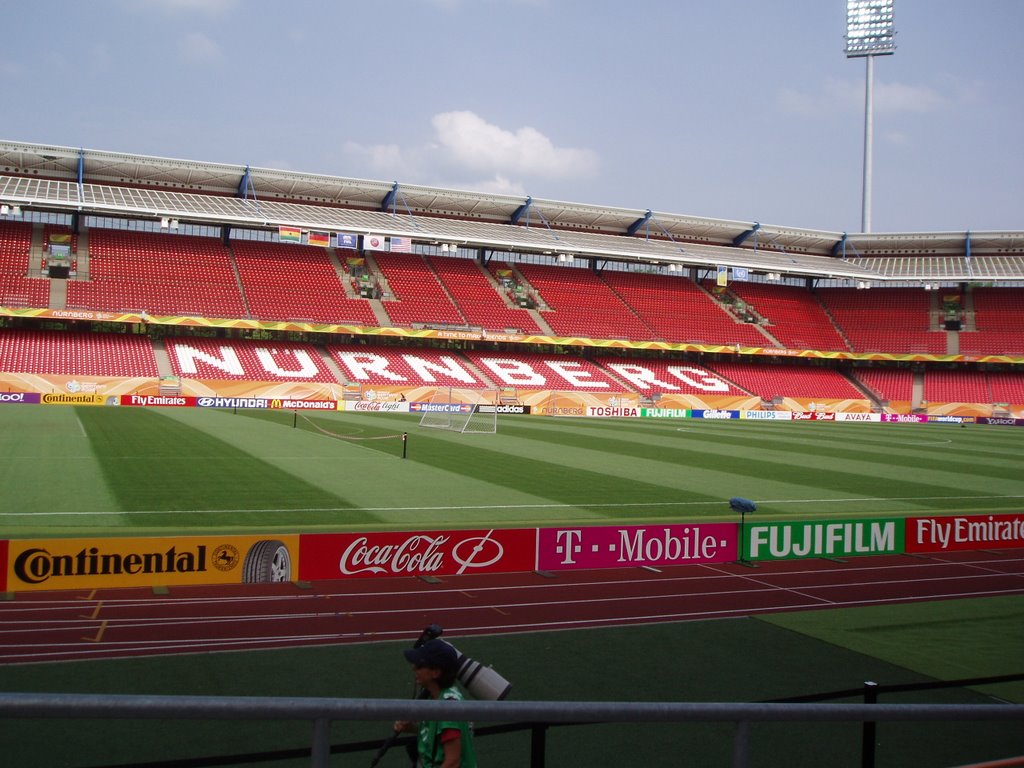
As for Nuremberg, we're staying in a rather ... eclectic place called the Hotel Smile, whose predominant motif is, you guessed it, a smily face. There's even one on the toilet seat. The decor's a little funky, but it'll do. Meanwhile, we're right next to the Colosseum-like stadium that Hitler used for massive Nazi rallies in the '30s. Sort of looks like Harvard Stadium, if Harvard Stadium had a really creepy vibe to it.

Finally, I'll note that the media center is right smack in the middle of a hockey rink, a practice rink located inside the large arena adjacent to the Frankenstadion. There are puck marks on the boards right behind the T-Mobile help desk, in fact. So in the spirit of my surroundings, I offer up a congratulatory chorus of "Brass Bonanza" to any Whalers fans out there. The Cup is yours. Sort of.

More tomorrow from the stadium as the journey (perhaps) comes to an end.

Monday, June 19, 2006

An off day


With no matches to cover and no stories assigned, I took the day off and explored Hamburg predominantly on foot. Unfortunately, I picked the only day it's rained in this city since my arrival.

I walked along the left bank of the Aussenalster, the larger of the Alster lakes, and had an Alsterwasser -- which is not water from the Alster, but beer with lemonade in it. Sort of like a Mimosa, but with a militaristic-sounding name. Much of the lakefront property is consulates, including two that are heavily protected by barricades and armed Polizei, belonging to ... you guessed it, the U.S. and Britain. I was going to take a picture of the U.S. consulate, but thought the Polizei might object.

I then took the subway to Blankenese, which is billed as the Amalfi Coast of Germany. Granted, it's a town built on a steep mountainside on a waterway, and it is picturesque, but I wouldn't say it's Tuscany North. Of course, the rain began falling when I got there, so I hightailed it out of there pretty quickly.

For dinner, I trudged through the rain to a German restaurant that billed itself as dated back to the 1600s. Nice place, decent food, and the traditional music ... of Bob Dylan and Tracy Chapman.

Anyway, we're going out for Guinness and to watch Spain crush Tunisia like a bug.

Sunday, June 18, 2006

It's too early in the morning for this

After getting about 3 1/2 hours of sleep, we got up, had breakfast and headed to the Mannheim Hauptbahnhof (main train station -- it's the most important German word I've learned so far) to catch the train back to Hamburg. As I entered the station, a young woman wearing pajamas approached me and said something in German.

Since it wasn't "Kaffee, Tee, Wasser?" or "Hauptbahnhof," I was lost. I mentioned that I didn't speak German, so she kindly translated: "Would you like to sleep with me?"

Now keep in mind, it's 10 a.m., and I'm going INTO the station with bags in my hand, and I just got out of a cab with two other guys with bags in hand. Isn't the answer to your question a bit obvious? Besides, ich habe ein Freudlin (inside joke).

Anyway, I simply said, "No, thank you" in English and went on my way, leaving behind the extraordinarily friendly (and entreprenurial) people of Mannheim.

Saturday, June 17, 2006

U.S. wins, 1-1


I hope TV coverage back home did tonight's match justice, both in terms of the atmosphere in the stadium and the magnitude of what the U.S. accomplished. With their World Cup life on the line, the Americans were playing 9 vs. 10 after two red cards, and they were facing an Italian team of such quality, patience and opportunism that a game-winning goal seemed a foregone conclusion.

But remarkably, the U.S. hung on. Steve Cherundolo was an unsung hero, covering virtually the entire right side of the field after the ejections. Landon Donovan ran at more defenders than I've ever seen him do before, especially in an international game, and he displayed some extraordinary skill. Oguchi Onyewu was an absolute monster on defense. The Revs' Clint Dempsey played 61 excellent minutes, forcing Totti to pick up a yellow card early and giving the Italian defense more to worry about in 15 minutes than the Czechs had to worry about in all of Monday's game. And DaMarcus Beasley, out of the doghouse, was a key to taking the pressure off the U.S. defense in the late going.

The U.S. crowd was also great, but it was the kind of match that evokes passions people might not know they have. All of the officiating controversy, the complaints about Italian play-acting, the circumstances of the match itself -- it wasn't a game where you could sit on your hands and wait for someone to start the wave. It sucked you in and didn't let go until the final whistle.

So Thursday's game means something after all. But even if the Americans don't advance (they need to beat Ghana, and have Italy beat the Czechs), they can hang their hat on this performance in Kaiserslautern. It might not be the best result in U.S. soccer history, but it must be the best effort.

U.S. lineups are in


Surprising news for the U.S. -- the Revolution's Clint Dempsey will start, as will Carlos Bocanegra. They're the lone additions to the lineup, and they replace Eddie Lewis and DaMarcus Beasley.

Still no word on how they'll be aligned -- could be a 4-5-1 with McBride as the lone forward, a 4-4-2 with Landon Donovan paired with McBride, or even a 4-4-2 with Dempsey and McBride up front.

Meanwhile, the usually staid media corps couldn't keep its emotions in for the Italy-Ghana match, which was chock-full of great chances and a couple of goals for the unheralded Ghanaians. The 2-0 upset turned this group on its head, and should give the Americans just a touch of confidence as they prepare to mount their own upset bid in an hour.

The game is afoot


The vaunted Czech Republic just gave up a goal to Ghana 70 seconds into the match. Given how thoroughly the Dutch and Argentines have dominated Group C, it might be time to proclaim Group E the toughest at this tournament. And the Americans, who were quarterfinalists four years ago, could be the worst of the four.

Three hours to game time in Kaiserslautern. The media center here is already packed, as were the trains from Mannheim 3 1/2 hours ago. It's a tiny city (only about 100,000 inhabitants), and the stadium is on a hillside that's part of the picturesque Palatinate Forest, so it's not the most accessible place.

On the train here, you could pick out the tourists -- they were the ones taking a picture of the railroad sign at Frankenstein a few miles down the tracks (I didn't have a good angle from my seat, so no photo).

More later...

Mannheim, but no steamroller


Greetings from the business center at the City Partner Augusta Hotel in Mannheim, our home base for the U.S.-Italy match today in Kaiserslautern (it's an hour away by train).

Yesterday we took another train down here from Hamburg, went to the U.S. press conference at the Fritz-Walter-Stadion (a very cool setting -- the stadium is on a mountainside, with a great view of Kaiserslautern), then came "home" to Mannheim. We had a great dinner at a Greek restaurant (Opa!) right across the street, then talked fußball (I finally get to use the accent mark! -- by the way, the ß is pronounced as a double-S) with some England fans and a couple of U.S. college kids in town for the match.

The other highlight yesterday was being interviewed by Spanish TV for a story they were doing about the American team´s decision to stay at Ramstein Air Base, located 20 miles from Kaiserslautern. Anything the team does that´s remotely related to the military is going to raise eyebrows in Europe due to the distaste for the Iraq war, but the mini-furor about where the team spends the night was a bit silly. Anyway, I told the Spanish guy that we´re Americans and we can do whatever we want, wherever we want, and to whomever we want, and that if he didn´t like it, he could take it up with Senor Rumsfeld.

Or I just said that the Americans were just staying at the base for convenience reasons and that they weren´t trying to provoke anyone or make a statement about their sense of security. I forget -- it was a long day ...

Anyway, I´m hogging the computer, so I´ll take my leave. More from K-Town when we get there.

Thursday, June 15, 2006

A taste of Dublin

We went to an Irish pub a couple of blocks away tonight for dinner, and to watch the second half of Paraguay-Sweden. The proprietor, a Dubliner named Aidan, boasted that he served the best pint of Guinness in Europe, including Ireland.

He’s pretty close – the Guinness was equal to what you get in Ireland, meaning it’s exponentially better (i.e., smoother, far less bitter) than its American counterpart. Guess it’s not Irish water that makes the difference after all.

It’s a relatively early night tonight, because we have an 8:30 a.m. train to catch. Going to Kaiserslautern, the city in the woods, for Saturday’s U.S.-Italy match. A full report on the proceedings tomorrow.

Cinderella has arrived


Trinidad and Tobago had auditioned for the part (and if they’d held on for a tie – or, perish the thought – a win against England today, they would have gotten it), but Ecuador has emerged as the Cinderella of the tournament, booking its place in the second round with a 3-0 victory over Costa Rica this afternoon in Hamburg.

Now 2-0-0, the Ecuadorans can actually win Group A if they tie the Germans in the first-round finale. Based on what we’ve seen so far, it could happen. Remember, Ecuador smoked Poland 2-0, while the Germans needed an injury-time goal to beat Poland 1-0 last night.

Ecuador has always been something a one-trick pony. Because of the altitude in their capital city of Quito (9,000 feet above sea level), they've dominated during home games in South American World Cup qualifying – they even beat Brazil and Argentina there in qualifying for this tourney. But without the best home-field advantage on their continent (and maybe the world), they’re just another team -- as a first-round exit at the last World Cup (Ecuador's first) attested.

Until now, that is. In this low-lying, port city, the Ecuadorans put on an impressive show, scoring three superb goals and exposing the Costa Ricans’ weaknesses. They capped it off with a bang, when Ivan Kaviedes headed home an Edison Mendez cross in stoppage time. That goal gave Ecuador a two-goal advantage over Germany in the race for first place. All the unheralded visitors will need is a draw, and they’ll win the group, which would be unbelievable. And pretty cool.